 |
 |
 |
Schizymenia pacifica
Slimy Leaf, Slippery Red Blade
17 May 2026
Willow Point North, Discovery Passage (south end), British Columbia, Canada.
Tide: 0.5 foot low at 12:11 pm PDT (measured at Campbell River Tidal Station)
Weather: Sunny, wind E 10 to 15 km/hour, sea rippled, humidity 60%, 15˚ C.
Moon: Waxing Crescent (1 day, 1.4%), Next phase, First Quarter, 23 May 2026 at 4:10am PDT; Previous Phase, New Moon, 16 May 2026 at 1:01pm PDT.
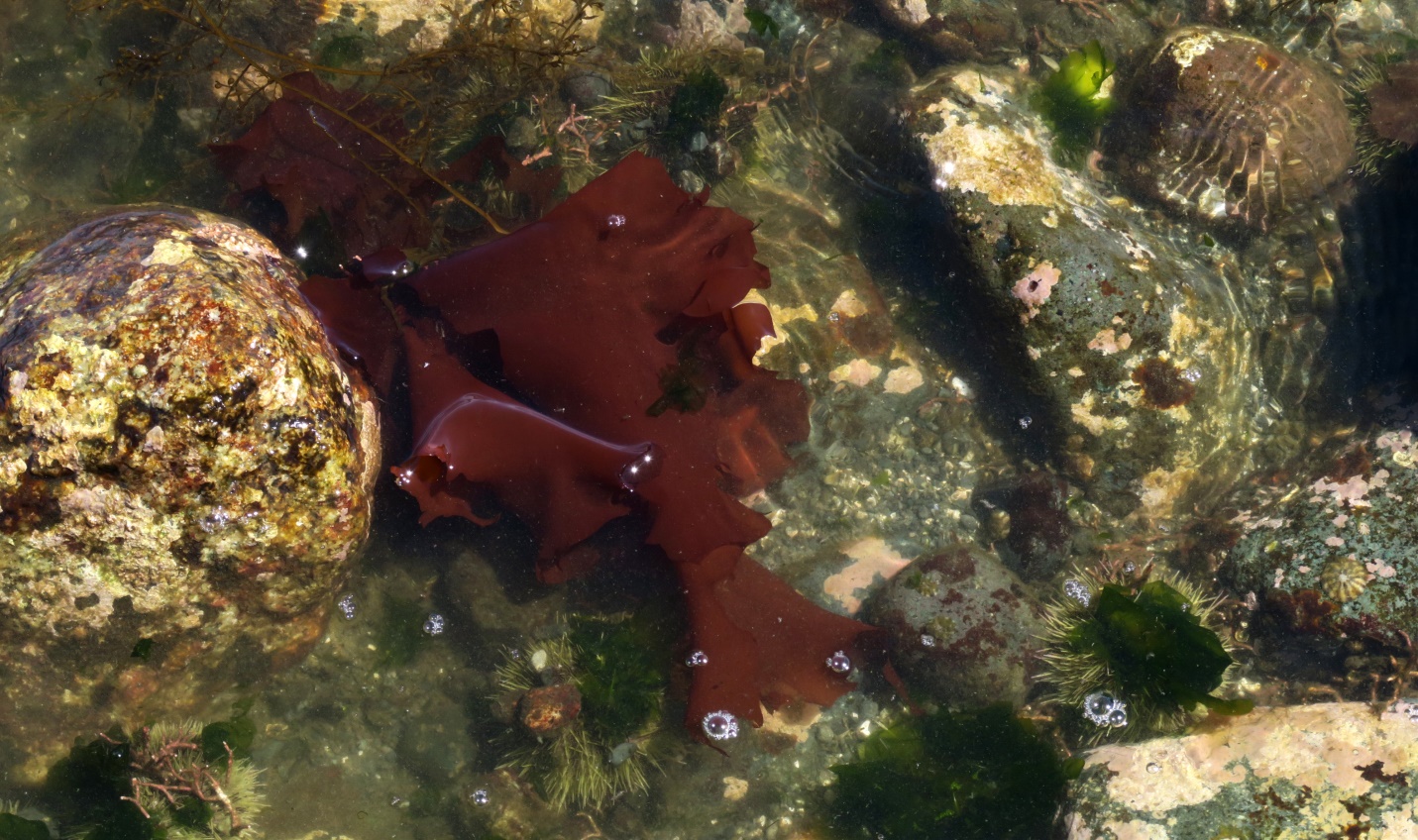
Figure 1: At a very low spring tide Shizymenia pacifica could be observed growing from large cobble on the shores of Willow Point North. Its rich red blades were constantly moving and folding and unfolding again with the gentle water action. Groups of blades grow together in a cluster and here you can see (in the foreground) four or five green urchins. The urchins have covered themselves with bits of coralline algae and are also largely draped with pieces of deep green Ulva – a favorite seaweed meal for these herbivores. Willow Point North, Discovery Passage (south end), B.C., Canada. May 17, 2026. Photo ID 27863 ©Seaweedwhisperings.com
Person 1:
Broad, red-brown blades radiating from a central location.
All individuals are the same color, almost no variation.
Highly slippery and slightly slimy to the touch, particularly when wet.
Sticky as it dries. Stickiness persisted on my fingers for a long time.
Often associating with Desmarestia viridis. These two seaweeds seem to be quite the opposites... D. viridis: long, stringy, much branched, laying out lengthwise, green. S. pacifica: smooth and shiny, broad blades, reddish brown.
Schizymenia pacifica is content and relaxed, no hurry.
Not easily upset or disturbed.
Perhaps naïve or unobservant of its surroundings. Might be surprised or shocked when things go sideways.
S. pacifica won’t bother others (is not the type to bother others). It might also be so unobservant it doesn’t notice that someone’s trying to bother them.
I am using the singular pronoun “it” in these notes when often I would be using the plural “they”. This might be because my sense of this seaweed being obviously individual. Individuals grow well spaced from other individuals.
They like the company of the group (lots of their own species here) but don’t want to be too close, perhaps a bit shy of interacting.
When tugged the blades stretch a bit, then suddenly tear in clean, longitudinal splits.
Interaction later same day:
I was thinking of a Schizymenia pacifica concept – “slippery..., to slimy..., to sticky” – a progression from one to the next. I got excited thinking about that, thinking deeply about that, and found I was going around in circles with it.
Before getting to sleep this night I had another interesting session – it was very detailed and got more and more detailed; it was about “rules”. Rules and regulations particularly related to wildlife protection. I got into thinking of minuscule details and then wondering, what actually are the regulations? I found myself getting my ‘nickers in a knot’ over these thoughts. It was a rabbit hole; there were just so many “what ifs”. I realized this thinking was not going anywhere good and I could feel tension in my chest. I realized that what I could do about this was simply to “give it up” or to “let it go”.
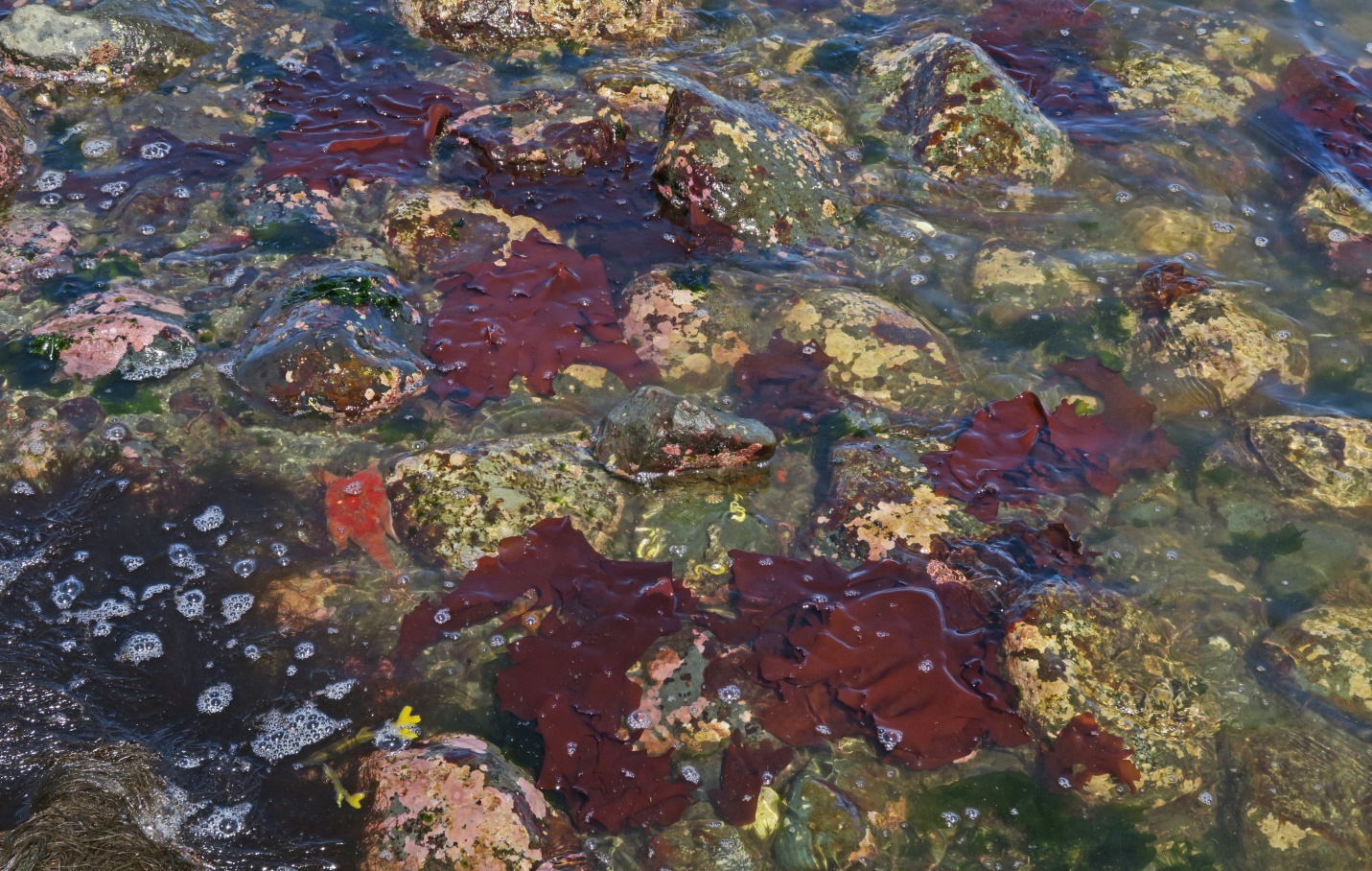
Figure 2: This area of the shoreline is usually sub-tidal, but with today’s very low tide many clusters of the red alga Schizymenia pacifica are easily observed. Willow Point North, Discovery Passage (south end), B.C., Canada. May 17, 2026. Photo ID 27864 ©Seaweedwhisperings.com
Person 2:
Spring low tide, just one day past the new moon. Here at the beach at Willow Point North we reach the waterline and find an array of seaweeds and sea critters. The species here are a little different than other locations as is to be expected – the type of substrate and sea exposure certainly influences populations.
Of note are:
groupings of the pink articulated coralline alga Calliarthron tuberculosum
many, many green sea urchins
sea cucumbers
leather stars
green acid weed, Desmarestia viridis
and then, amply spaced and anchored to cobbles, the bigger, rich red-colored, somewhat tattered ‘sheets’ of Schizymenia pacifica.
I watched one set of these blades, common name “slimy leaf”, as they wafted in the lapping water and laughed to see a kelp crab somehow holding on. It seemed like a difficult thing to do because in the moving water Schizymenia’s broad blades slip and slide and fold over themselves with total ease!
Slipping, sliding, ever moving and ever changing its position.
We’ve known this red alga can be ‘identified’ by a slimy feel to the touch – and, yes, it is. But ‘slimy’ is a word I associate with decay or something somewhat unpleasant. This particular slimy of Schizymenia lingers a bit on the fingers (transfers from seaweed to human by contact) but it isn’t a decomposition-type of slime. It feels to me that it is more like a protective coating slime layer, perhaps like how in humans mucus membranes are moistened and lubricated if they are to function well.
Lubricated – yes, Schizy is lubricated all over its surface so that the blades can move and slip over themselves and not cause friction, heat, or other harm.
The red is gorgeous; rich and full – not a watery red like neighboring reds but a red that has substance, as if it is engorged with blood. Some sets of blades are more brownish red, but most are a deep, full, healthy looking red.
The blades grow in clusters, and can cover quite an area as they spread their breadth in the water. With the constant ocean swell these blades lift and shift and fold and unfold with each other. They seem to want to be able to move freely, uninhibited by crowding.
Each grouping of blades that arises from a single holdfast area is uniformly colored – and even though the blades are not very thick, they are also not translucent. This is in strong contrast to another red alga that is abundant at the higher intertidal zone in this same area, Wildemania occidentalis. W. occidentalis is commonly known as ‘red cellophane’ because you can see through it easily. Schizymenia pacifica is more like a piece of matte silk, thick and richly colored and slippery but not truly as shiny as satin might be.
Maybe the opaque red blades are great cover for creatures that need places to hide. The opacity of the blades blocks things, creates a kind of shifting shelter that can be useful to others.
Newly exposed out of water, the blades reflect the strong sunlight here today, and this comes more from the smooth surface and the residual water held on the surface of the blade than anything else. As the blades dry a bit in the air and sunshine, you can see very fine wrinkles all over the surface. Indeed this is reminiscent of the look of tanned leather. These kinds of wrinkles are the marker of something that can stretch and then retract back to size. Ah, yes, they’re ‘stretch marks’.
And indeed the blades are stretchy – to a point. If stressed too much, then the blade tears. This tearing happened as I was testing the stretch of a blade, and it was very quick and left a clean edge on both sides of the split. So it seems that Schizymenia can bear some strain easily and retain its integrity, but certain other strains are not endured at all. Why? What is the difference?
Is Schizymenia endowed most strongly with traits that allow everything to slip and slide away from it – a kind of defense to avoid strains from ever occurring in the first place? Then if there are times when something does ‘grip’ one of Schizy’s blades and tension results, well..., there is no protection at all against tearing.
These tears do happen naturally (not just as the result of curious human handling) and maybe the fact that Schizy can tear very cleanly is something to note. For Schizymenia if a tension occurs, well, it’s not going to fight it, it’s going to let go, cede to the forces affecting it, and rip cleanly through in order to then be finished with it all. There’s no long or drawn out struggle. If the strain or tension is too large the answer is to not resist at all; the damage is swift and then it’s done. The blade, now in two pieces, can continue its movement.
It is hard to say for sure, but it doesn’t seem that these tears are points of weakness for the seaweed. I didn’t find signs of decay or illness at the torn edges. Instead it seems that Schizy, as life interactions happen, progressively gets divided into a greater number of pieces. The pieces all seem to function and they still connect at the holdfast, so perhaps that is all workable enough.
This seaweed has a preference to live in wave exposed habitats. Such a broad blade is perhaps not the best design for living in such conditions, but the way Schizy meets that problem is to ensure that its big wide blades do not rub each other in a harmful way. The slimy / slippery surface enables the ‘sheets’ of red alga to slip and slide over each other without generating any friction or heat.
Friction and heat are two words that are often associated with the human emotion of anger. Anger can be very damaging in human relations. So does Schizymenia have a natural ‘slime / lubricant’ that prevents damage? As an energetic trait this means that if anger should arise it really can do nothing but slip and slide right off?
I think this is very much what happens, except if this seaweed is exposed and the lubrication starts to become sticky!! At Willow Point I sensed that the individuals that were slightly higher in the intertidal zone were not enjoying being exposed out of water with the low tide. They were, of course, no longer doing their constant shifting and wafting movement, and seemed to be ...... a bit miffed (annoyed, peeved, irritated) at needing to await the return of the tidal waters. Schizy can tolerate this temporary exposure, but it does leave its mark (the stretch marks like tanned leather) and maybe at these ‘exposed’ times, the potential for damage and hurt is felt in the very ‘skin’ of this seaweed. Their resilience and resistance to harm is less strong; their vulnerability increased. One could say that any seaweed exposed to sun and wind at low tide is in a vulnerable and far from ideal circumstance, but Schizymenia seems to present to me as being more vulnerable in this way than others. Schizy has an all “laid bare” kind of look when exposed – and with its bright red coloring this is rather obvious to anyone who should care to look.
Lack of movement with the waves causes a slowing, maybe a dormancy or temporary cessation of movement of the very vitality of this seaweed; the blades have needed to switch to ‘rest mode’ and possibly ideally this seaweed would live sub-tidally and never need to face the ‘exposed’ and ‘forced-to-rest’ mode.
Why do we find them in this situation then? Water currents can be felt in deeper waters, but with wave action and sea swell, the greatest activity is closer to the surface. So there is a fine line here and finding the best spot to enjoy constant movement would involve being close to the surface (where the most action is) but not too far above it where at low tides exposure and dormancy and vulnerability lies.
During this interaction today I felt the concern of trying to not do harm and also to not be harmed myself. Stepping near Schizymenia pacifica there were green urchins everywhere. If I had to step on Sargassum covered areas once or twice I heard / felt a crunch occurring. My passage was damaging / harming the urchins hidden underneath the seaweed cover. Simultaneously it felt tricky to walk here where Schizy is growing; the large rounded cobbles that were covered in wet seaweed were very slippery. Even stepping in the troughs of the cobble meeting places, it felt like my feet could slide out from under me if I wasn’t super careful and slowly and deliberately choosing my steps.
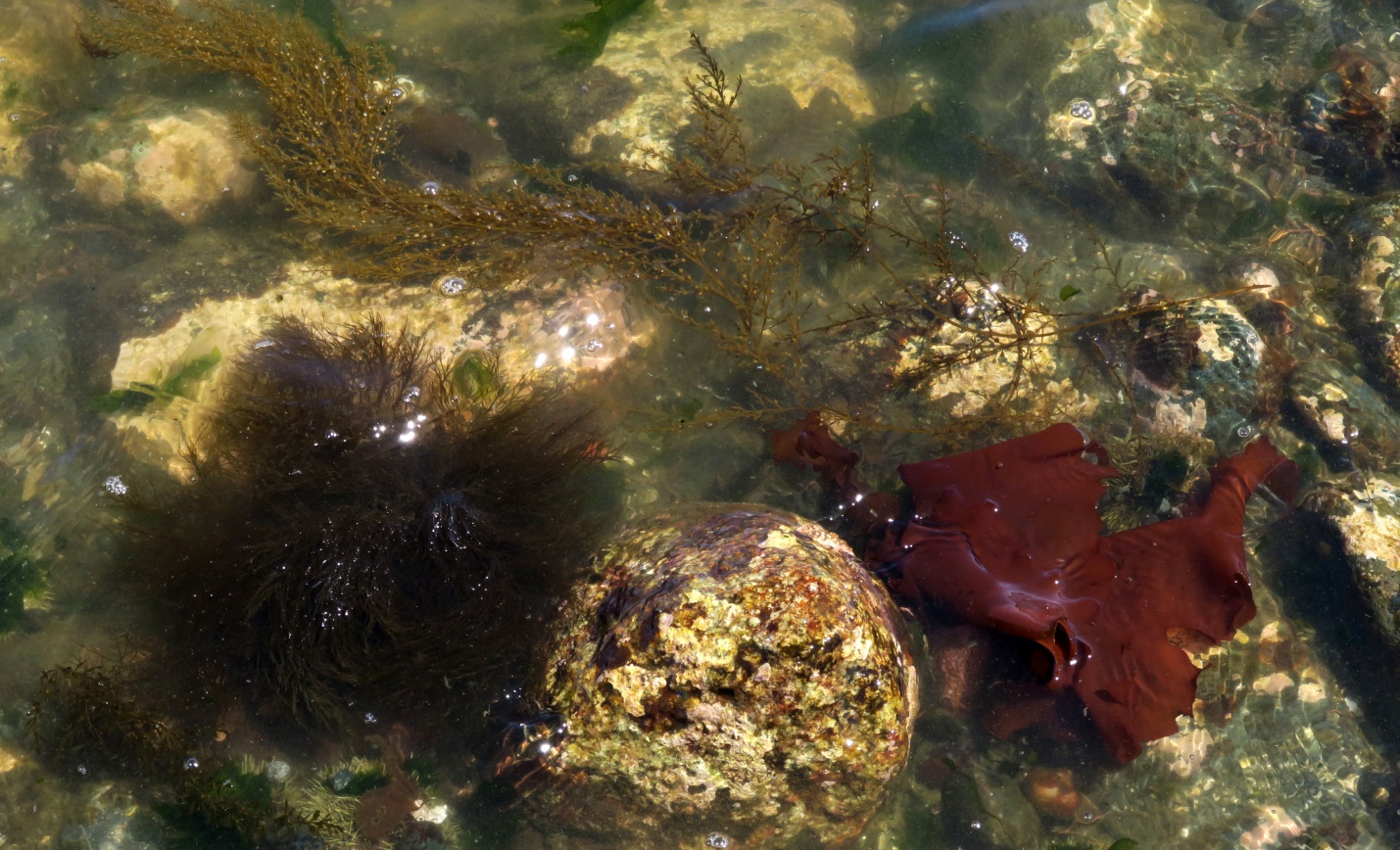
Figure 3: This photo shows three macro algae species that were common here today. On the left of the central rounded cobble there is Desmarestia viridis, above it is the golden green colored Sargassum muticum and to the right is our species of interest, Schizymenia pacifica, commonly known as Slimy Leaf or Slippery Red Blade. Willow Point North, Discovery Passage (south end), B.C., Canada. May 17, 2026. Photo ID 27865 ©Seaweedwhisperings.com
Discussion:
The Schizymenia concept of ‘Slippery, slimy, sticky’ showed us some interesting things. Getting excited about thoughts..., to the point of going around in circles with them..., becoming engrossed with details..., all building up to a tension that requires a “giving it up” or a “letting go” solution – this was interesting.
Schizymenia looked so content and relaxed to Person 1 when he was interacting with it at the seashore but during later interaction with the seaweed’s energy Person 1 was seeing the opposite side – a tension / type of fear or anxiety that can be viscerally experienced in the body. For Schizy, that letting go of the tension could be why it tears – the membrane (body of the seaweed) lets go and then the tension is instantly dissolved.
It appears that for this seaweed the slippery to slimy to sticky/stuck progression can involve becoming too caught up in details or preoccupied with theories and interpretations. And it appears also that when Schizymenia is presented with rules and regulations that it does not like and when going with the flow and simply being ‘slippery’ does not give them any solutions, then one of the ways Schizy chooses to handle that is by becoming a bit ‘slimy’. So, to avoid compliance with rules slimy thoughts / words / deeds are used or undertaken. When the ‘slimy tactics’ become exposed, when they are found out, then things get really ‘sticky’. Schizy can’t move – Shizy is caught. There’s no way to slip and slide out of it. Or at least at this point Schizy cannot see any way out.
Not seeing any way out reminds us of the opacity of the Schizymenia blade. Something that is opaque obscures or confuses things, it doesn’t let light pass through.
With the concept of opacity we thought about how this can include hiding one’s true thoughts and feelings. We felt this something Schizymenia might resort to, especially when faced with something they don’t understand, or with a rigid rule presented by an unbending authority.
‘Going around and around in circles’..., this was a thought pattern that our attention was brought to by this seaweed. The morphology of the big broad flexible blades and the physics of being always anchored at one point and subject to the forces of water movement at other reaches of the blade..., well, that means that the overall movement of this seaweed, if traced in three dimensions, would likely be in various kinds of ellipses and sometimes even circles. That is simply physics; what the issue is here is that the consequence of ‘going around in circles’ is experienced and it builds (even if you are going around in ellipses and not perfect circles) – the anchor point is determining a limit to what you can see, to how you can move, to where you can reach. This feeling for Schizymenia was at first exciting, but then frustrating, and finally tense and fearful.
There is an interesting pairing of two of the physical features of Schizymenia pacifica. First is that the blades have such a deep red color – a red of such substance that they are opaque. Then secondly there is this aspect: when touching the “slimy leaf” underwater, it indeed feels very slippery, and it also feels as one’s fingers are not quite touching the surface of the blade but sliding along over some invisible layer / field that existed between the leaf and hand. This ‘layer’ was not visible at all. Later we consulted phycology texts and found that it is agreed that the slimy quality is not due to a mucus secretion created by the seaweed, but the “layer” is there, and the slimy texture is, too. Whatever creates this, it gives Schizymenia exactly the kind of life it wants to live – ease of movement with no friction or heat.
Strong mental function in terms of many thoughts and ideas arising, along with a very strong capacity to remember them all, was noted. It seems that Schizy, when its energy is flowing well, has a very clear and quick memory. This feels good, it is a strong point of power for them.
Socially there is a conflict or internal tension between wanting to belong and wanting personal space. It was felt that wanting space at times could involve shyness, but also we noted that space was desired because uninhibited movement is a joy to this seaweed. Crowding is not desired, but having your fellow kind ‘within shouting’ distance is perfect.
This seaweed loves to be slippery and slimy or lubricated and moving with water action; it does not like being sticky and immobile. It’s almost like lack of movement becomes a stagnant state and Schizy’s internal energy slows its flow. Could this slowing be needed? Does it teach or toughen up this seaweed, spurring it along to its annual maturity? Early season (younger life) does not present this seaweed with many periods of ‘exposure’ and stress, so perhaps the extreme low tides of late spring really do usher in important developments. When all is good, slipping and sliding with total ease..., not much needs to change or be learned. When that stops, or is halted for notable periods, it will demand an adaptation, evolution of thinking and being.
We noted that Schizymenia pacifica can be very good at letting go, allowing things to just slip and slide away, like water off a duck’s back. We pondered that if at times this may be a limitation or pitfall; that sometimes Schizy might let go of feelings almost as soon as they’re registered. Maybe the ‘sticky’ periods provide them with the time for noting and acknowledging and learning from any stuck feelings. Surely then when the tide returns, letting go will come after some growth and learning has been achieved.
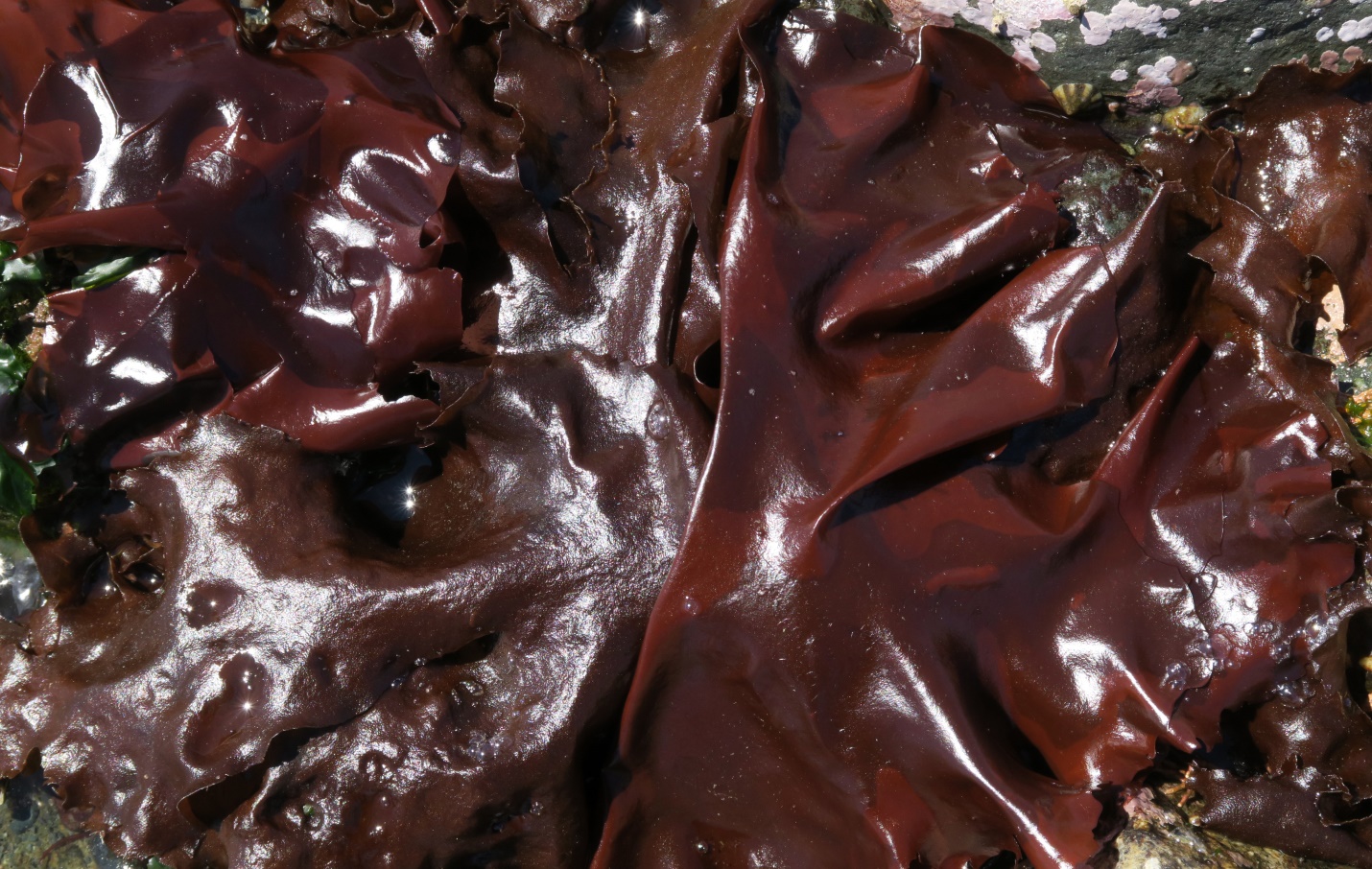
Figure 4: A closer view shows the texture of the blade – it has been described as looking like tanned leather. Willow Point North, Discovery Passage (south end), B.C., Canada. May 17, 2026. Photo ID 27866 ©Seaweedwhisperings.com
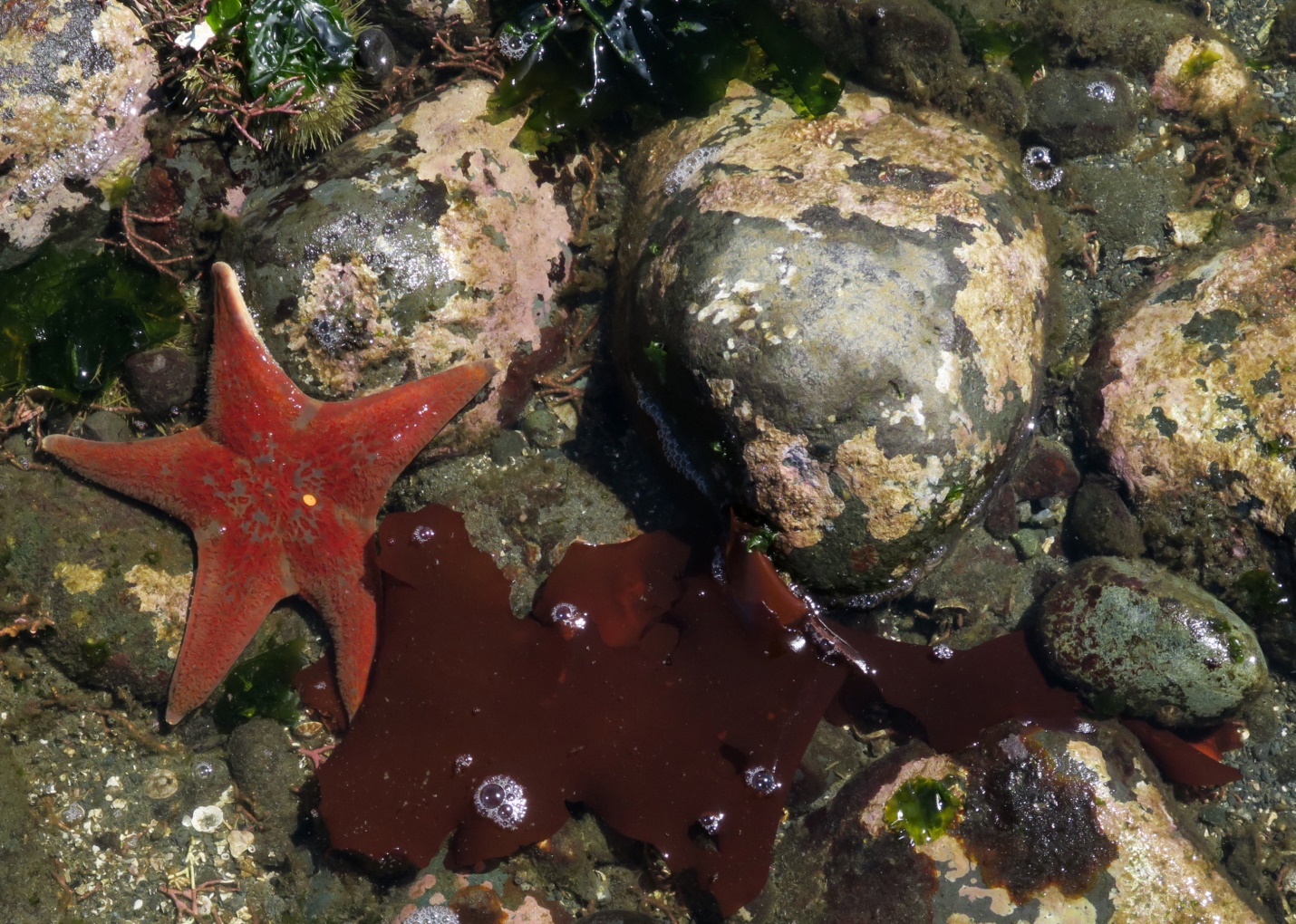
Figure 5: There is a repetition of common names with these two life forms. Dermasterias imbricata, is commonly called the ‘leather’ star, and Schizymenia pacifica is a red alga that has a texture that has been described as having a texture that looks like tanned leather. At this site we found many leather stars in the region where Schizymenia pacifica was growing. Interestingly, the upper surface of the leather star is smooth and velvety – a contrast from most other sea stars which are spiny and the leather star boasts a light layer of mucus atop its smooth surface, too. Schizymenia pacifica is also very smooth and slippery to the point of slimy, although mucus does not seem to be what provides that trait for the seaweed. Willow Point North, Discovery Passage (south end), B.C., Canada. May 17, 2026. Photo ID 27867 ©Seaweedwhisperings.com
Biology & Natural History Information:
Description:
Thallus is a slippery brownish red blade which grows in dense clusters, attached to rock by a short inconspicuous stipe that arises from a small discoidal holdfast. They may reach 60 cm (24 in) in length but usually are less than 30 cm (12 in) long. The irregularly lobed blades can be quite broad to roundish, often deeply split, and while the main expanse of the blade is flat the edges are gently ruffled. The look of the surface of the blade is similar to tanned leather and the touch of this blade is very slippery or even slimy – a feature that is not common to other bladed red seaweeds. The seaweed produces no obvious mucus or slime and viewed under a microscope the blades are covered in colorless, narrow, elongate gland cells; it has been suggested that these gland cells may harbor chemical compounds that contribute to the slippery surface texture of the blades.
Habitat:
This annual grows on rock in the low intertidal and subtidal of wave exposed habitats. In a curious association, this seaweed is known to sometimes grow on the backs of an intertidal invertebrate, the largish-sized, black colored chiton named Katharina tunicata.
North Pacific Distribution:
Japan; Aleutian Islands, Alaska, to Baja California, Mexico; Russia.
Remarks:
Type locality, Friday Harbor, Washington.
‘Schizymenia’, derived from the Greek means ‘split membrane’ or ‘split skin’ (‘schizo’ – to split, cleave or divide, and ‘hymenia’ – meaning membrane, skin, or layer). The irregularly lobed roundish blades can frequently become lacerated; they tear easily, dividing lengthwise towards the holdfast.
The gamete-bearing (broad leafy) phase of this red alga alternates with a crustose, spore-bearing (tetrasporophyte) phase that was originally thought to be a unique species – Haematocelis rubens. Life history studies corrected this misconception. The tetrasporophyte is a thick fleshy crust that is difficult to identify and rarely reported.
Classification:
Empire: Eukaryota
Kingdom: Plantae
Subkingdom: Biliphyta
Infrakingdom: Rhodaria
Phylum: Rhodophyta
Subphylum: Eurhodophytina
Class: Florideophyceae
Subclass: Rhodomeniophycidae
Order: Nemastomatales
Family: Schizymeniaceae
Genus: Schizymenia
Species: Schizymenia pacifica (Kylin) Kylin 1932
Former name(s): Homotypic synonym: Turnerella pacifica Kylin 1925
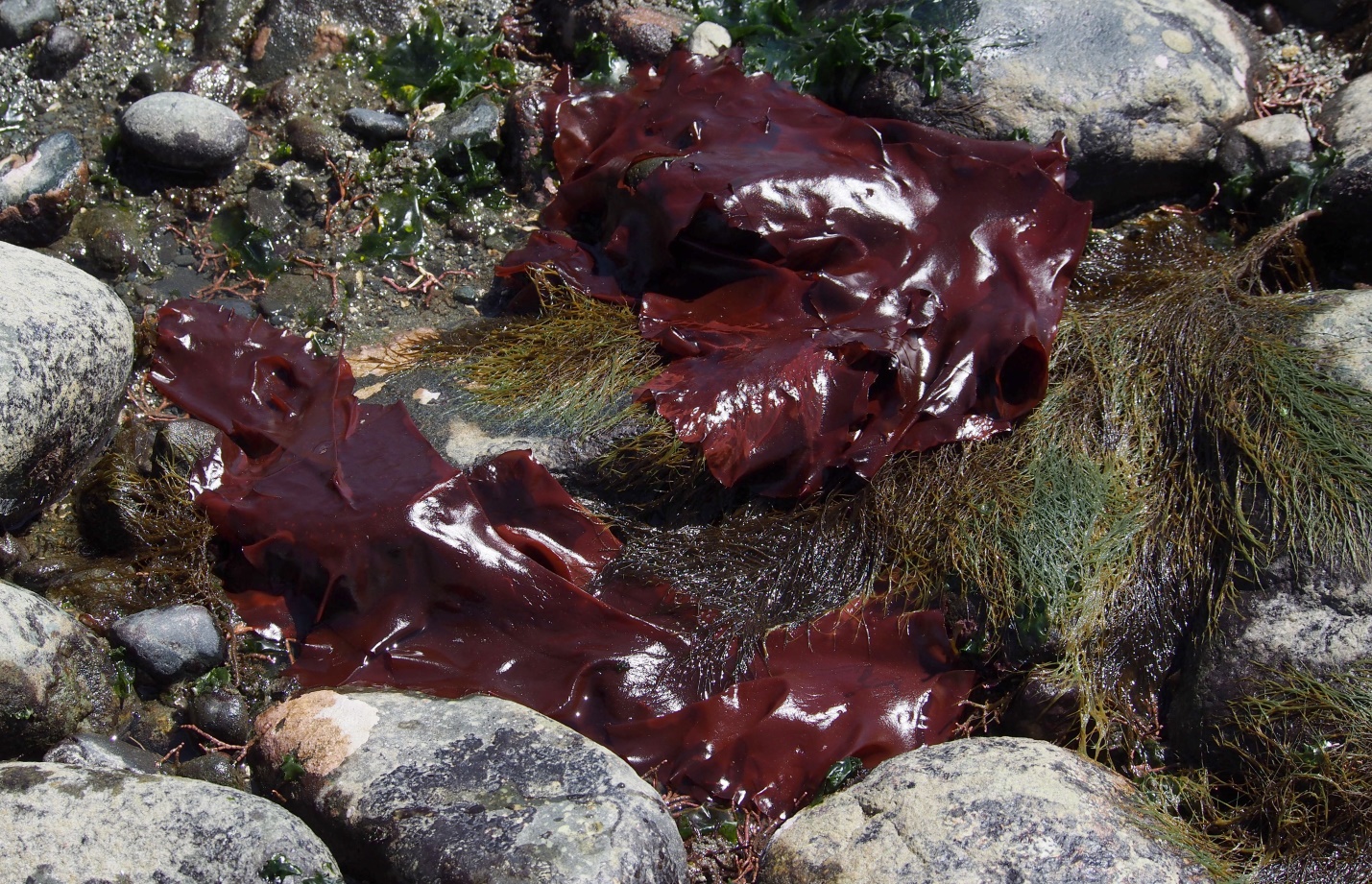
Figure 6: Schizymenia pacifica is seen here along with Desmarestia viridis. One is broad bladed and deep red, while the other seaweed is many branched and brownish green. Neither is faring all that well with the exposure at this very low tide and the stress can be perceived if you pause and observe. Willow Point North, Discovery Passage (south end), B.C., Canada. May 17, 2026. Photo ID 27868 ©Seaweedwhisperings.com
